Does Masturbation Cause ED? Understanding the Possible Link

✅Medically reviewed | Updated September 2026
Few sexual health questions attract as much private worry as this one. Men type it into search bars late at night. Many carry guilt. Many fear lasting damage. Rumours spread fast, while reliable answers arrive slowly.
So, does masturbation cause ED? Current evidence says ordinary masturbation does not cause erectile dysfunction. The NHS lists physical and psychological causes of ED. Masturbation appears on neither list.
The full picture holds more detail. Pornography use, forceful technique, shame and performance anxiety can each influence erections in some men. Persistent erection problems also signal conditions such as diabetes or heart disease. Separating myth from fact protects both sexual confidence and general health.
This article reviews the research behind the question. It explains how erections work, which habits deserve attention and which conditions cause most cases. It also outlines evidence-based treatments, including the P shot, and states the limits of current evidence.
Does Masturbation Cause ED? The Short Clinical Answer
Current evidence does not link normal masturbation habits to erectile dysfunction. UK guidance supports this position. NICE Clinical Knowledge Summaries describe vascular, neurological, hormonal, medication-related and psychological causes of ED. The NHS gives a similar list. Neither source names masturbation.
What ED Means
Clinicians define erectile dysfunction as the persistent inability to get or keep an erection firm enough for satisfactory sex. Occasional difficulty does not qualify. Stress, tiredness, alcohol and illness all cause temporary lapses in healthy men.
ED becomes more common with age. Population studies suggest that roughly half of men aged 40 to 70 experience some degree of ED. Age remains the strongest single predictor of erectile difficulty.
What the Research Shows
Researchers have tested the question directly. Rowland and colleagues studied pornography use and masturbation in men with and without ED. Masturbation frequency showed a weak association with erectile function, or none. Age, anxiety, depression, low sexual interest and low relationship satisfaction predicted ED far more consistently.
This finding shifts attention from a harmless habit to measurable risk factors. The research answer to does masturbation cause ED therefore remains no. It also explains why clinicians rarely ask men to stop masturbating as a treatment for ED.
Research limits deserve honest mention. Most studies rely on self-reported behaviour. Sexual habits are private, and reporting may lack accuracy. Few trials follow men over many years. Conclusions therefore stay probabilistic rather than absolute. Even so, no study has shown that ordinary masturbation damages erectile function.
How Erections Work and Why Masturbation Does Not Wear Out Erectile Tissue
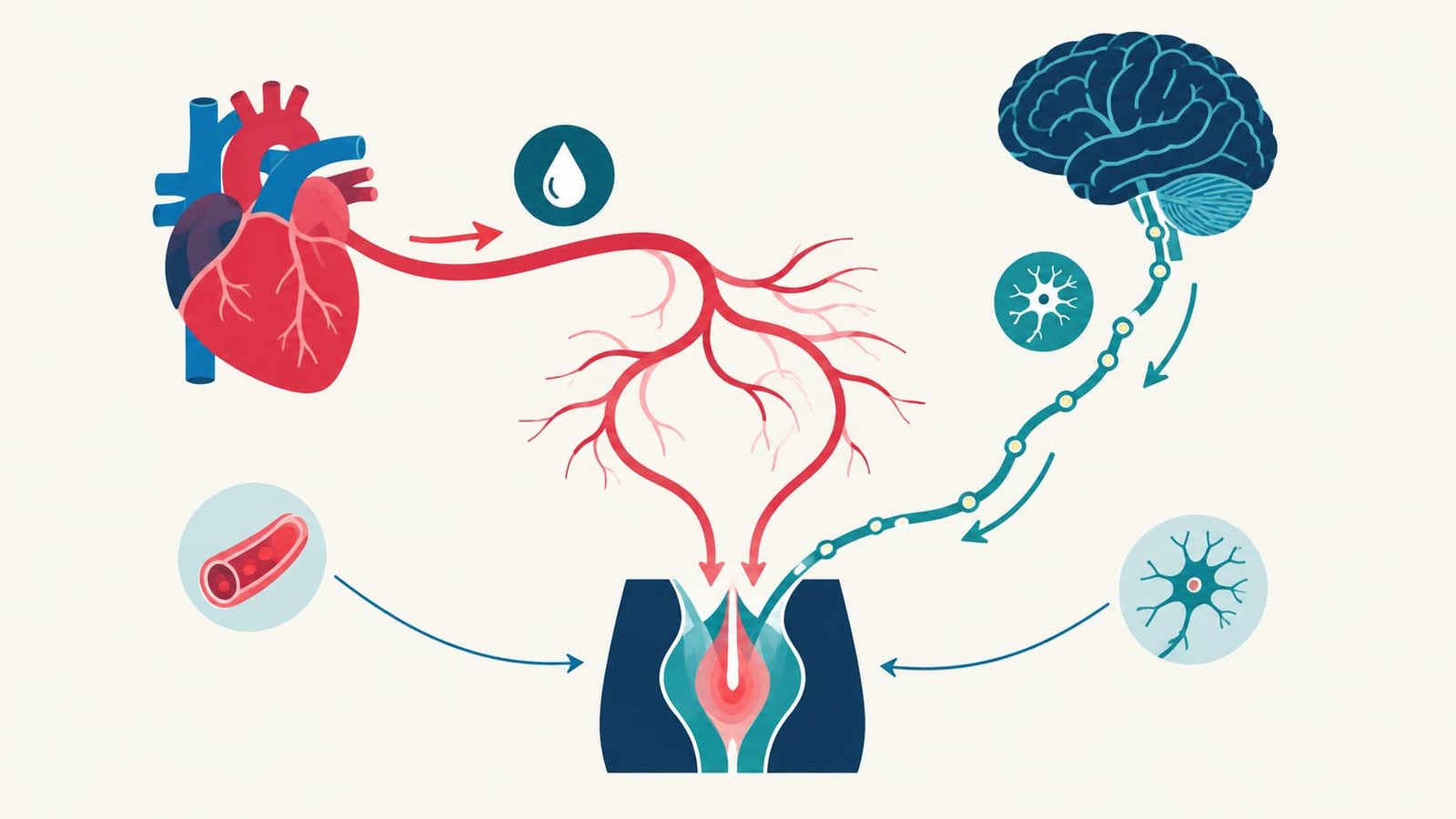
The Vascular Mechanism
Erections depend on blood flow. Sexual arousal triggers nerve signals. Nerve endings release nitric oxide. Nitric oxide relaxes smooth muscle in the penile arteries. Blood then fills two erectile chambers, the corpora cavernosa. The expanding tissue compresses the veins and traps blood. The penis becomes firm.
Masturbation uses the same pathway as partnered sex. Regular use does not deplete a finite supply of erectile capacity. Erectile tissue behaves like a blood vessel network, not like a battery. Researchers have proposed that regular erections support tissue oxygenation. Evidence for this idea remains limited.
The Refractory Period Is Not ED
Every man enters a refractory period after ejaculation. Arousal and erection become difficult or impossible during this phase. The length varies from minutes to a day or more. It often lengthens with age.
A man who masturbates shortly before partnered sex may struggle to reach a second erection. That response reflects normal physiology. It does not indicate ED.
When Masturbation Habits May Contribute to Erectile Difficulty
Masturbation itself does not cause ED. Certain patterns around it may contribute in some men. Research remains limited, and cause and effect stay unproven.
Pornography Use and Arousal Patterns
A 2016 review in Behavioral Sciences by Park and colleagues discussed ED in men under 40. The review examined heavy internet pornography use. The authors proposed a possible link. The authors suggested that constant novelty and intense stimulation may raise arousal thresholds.
The review relied on clinical reports. It cannot prove causation. Internet access and ED diagnoses in younger men rose during the same period, and timing overlap alone proves nothing. The Rowland study later found weak or no association between pornography use and ED severity.
Performance anxiety offers a more plausible route. Men who compare partnered sex with pornography may worry about erection quality. That worry can trigger ED by itself. Anxiety, rather than pornography, may drive many of these cases.
Forceful or Atypical Technique
A 2023 matched case-control study by Can and colleagues compared young men with and without ED. Men with ED had a 2.2-fold higher risk of at least one atypical masturbatory behaviour. Examples included rubbing in a prone position, applying firm pressure and masturbating through clothing.
Clinicians sometimes call this an idiosyncratic masturbatory style. The proposed mechanism involves conditioning the body to respond to intense, specific pressure. Partnered sex then feels less stimulating. The study shows association only. Clinicians commonly advise lighter pressure and varied positions, although evidence for this advice remains modest.
Guilt and Shame
Psychological distress matters. Case literature in the Journal of Sex & Marital Therapy describes guilt about masturbation coinciding with depression and ED. Strict religious or cultural teaching often played a part.
Anxiety raises sympathetic nervous activity. That activity opposes the smooth muscle relaxation an erection needs. Guilt can affect erections even when the habit causes no physical harm.
Frequency
Does masturbation cause ED when frequent? No evidence identifies a frequency that causes ED. Clinicians consider frequency a concern only when it disrupts work, relationships or wellbeing. Compulsive patterns deserve a conversation with a GP or psychosexual therapist.
Common Myths About Masturbation and Erectile Health
Several myths shape the question does masturbation cause ED. Evidence contradicts each one. Clear facts reduce needless guilt, and guilt itself can worsen erections.
Myth: Masturbation Damages the Penis
Gentle masturbation does not injure erectile tissue. Injury can follow excessive force. Clinicians treat such injuries as trauma, not as ED caused by the habit itself.
Myth: Masturbation Drains Testosterone
No robust evidence shows that masturbation lowers testosterone enough to cause ED. Low testosterone remains a genuine cause of ED. A blood test, not guesswork, confirms it.
Myth: Stopping Masturbation Restores Erections
No reliable trial supports abstinence as ED treatment. Advice to stop may even raise guilt and anxiety, which worsen erections. Treatment works best when it targets the actual cause.
More Likely Causes of ED
Most cases trace back to health and lifestyle factors. NICE and European Association of Urology guidance both highlight vascular disease as a leading cause.
Physical Causes
Common physical causes include:
- Cardiovascular disease and atherosclerosis
- High blood pressure
- Type 2 diabetes
- Obesity and metabolic syndrome
- Low testosterone
- Chronic kidney disease
- Multiple sclerosis, spinal injury and pelvic surgery
- Peyronie’s disease
ED often appears before other signs of heart disease. Urology literature describes ED as frequently the earliest manifestation of cardiovascular disease. Penile arteries are smaller than coronary arteries, so vascular damage can show there first. A GP visit for ED therefore protects long-term health.
Psychological Causes
Stress, anxiety, depression, relationship difficulty and low self-esteem all disrupt erections. Younger men show psychological causes more often. Across all ages, estimates place purely psychological ED at roughly 10 to 20 per cent of cases.
ED and anxiety also feed each other. One failed erection raises worry. Worry then raises the chance of another failure. Clinicians call this the vicious circle of performance anxiety. Breaking the circle often restores erections without any physical treatment. Men with persistent low mood, loss of interest or sleep problems should also seek support. Depression and ED often coexist.
Lifestyle and Medication Factors
Smoking, heavy alcohol use, inactivity and recreational drug use all raise risk. Some prescribed medicines also affect erections. Examples include certain antidepressants, some blood pressure tablets, antiandrogens and some ulcer treatments. Nobody should stop a prescribed medicine without medical advice.
Warning Signs: When to See a GP
The NHS advises seeing a GP when erection problems persist or cause distress. Early assessment matters because ED can reveal treatable disease.
Erections in Different Situations
Clinical guidance treats erections during masturbation or on waking as a useful clue. These erections suggest that blood vessels and nerves still function. Psychological factors then become more likely. A man who loses erections in every situation needs a fuller physical assessment.
What a GP Assessment Involves
NICE Clinical Knowledge Summaries outline a structured review. The GP takes a sexual and medical history. The GP reviews medicines, checks blood pressure and measures weight. Blood tests often include glucose or HbA1c, lipids and morning testosterone. Some clinicians also use the International Index of Erectile Function questionnaire.
Evidence-Based Treatment Options
NICE guidance advises treating underlying causes first. Treatment then matches the cause and the man’s preferences.
Lifestyle Changes
Stopping smoking, reducing alcohol, exercising and losing excess weight all improve vascular health. European and UK guidance both support lifestyle change alongside other treatment.
Psychosexual Therapy and CBT
Cognitive behavioural therapy helps men with performance anxiety, guilt or relationship stress. Studies show that combining sex therapy with medication can outperform medication alone.
PDE5 Inhibitors
Sildenafil, tadalafil, vardenafil and avanafil form the first-line drug group. These tablets enhance the nitric oxide pathway. The tablets need sexual stimulation to work. A GP or pharmacist checks suitability, especially for men who take nitrates. Men who take nitrates must avoid PDE5 inhibitors. An erection lasting longer than four hours needs urgent medical care.
Devices, Injections and Surgery
Vacuum devices, alprostadil (urethral or injected) and penile implants serve men who cannot use tablets. These options also suit men who find tablets ineffective. Specialist urology teams supervise these options.
Where the P Shot Fits: Evidence and Limits
What the P Shot Involves
The P shot (P-shot or Pshot in some spellings) uses platelet-rich plasma (PRP). A clinician draws a small blood sample. A centrifuge concentrates the platelets. The clinician then injects the concentrate into penile tissue after local anaesthetic. Marketing terms include priapus shot, penis shot and p injection.
Proponents suggest that growth factors in PRP support tissue repair and new blood vessel formation. Human evidence for this mechanism remains incomplete.
What the Evidence Shows
A 2021 randomised trial in the Journal of Sexual Medicine reported improved erectile function after PRP compared with placebo. A 2023 randomised trial in European Urology reported mixed findings. Sample sizes remain small and follow-up remains short.
Current UK guidance does not list PRP among first-line ED treatments. European Association of Urology guidelines describe it as investigational. P shot treatment therefore suits selected men, after assessment, rather than every man with erection concerns.
Relevance to Masturbation-Related Concerns
The P shot does not address masturbation habits, guilt or performance anxiety. Men with those concerns need psychosexual assessment first. PRP targets tissue and vascular causes of ED. Clinicians exclude reversible causes before discussing any injection.
Clinicians at pshots clinic UK assess erectile concerns at a Harley Street practice in Marylebone, London. Dr Syed Nadeem Abbas (MBBS, MRCS, MRCGP, MSc Aesthetic Plastic Surgery) leads the practice.
Cost, Results and Realistic Expectations
Priapus shot price at UK clinics generally ranges from £900 to £1,500 per session. Clinician experience, PRP preparation and package structure affect the figure. Higher price does not guarantee better results.
Searches for male enlargement injections cost UK often confuse the P shot with cosmetic filler. PRP has no proven power to enlarge the penis. Reports of penile injection growth lack reliable clinical support. Filler injections for girth carry separate risks, including nodules and infection.
P shot before and after images also need cautious reading. Lighting, arousal state and timing change how photographs look. P-shot before and after galleries cannot prove treatment effect. Individual response varies, and some men notice no change.
Risks include bruising, pain, swelling and infection. Men who search for P Shot London or P shot UK providers should verify Care Quality Commission registration. A doctor should also carry out the assessment.
Practical Steps for Men Worried About Masturbation and ED
Men who ask does masturbation cause ED often need practical next steps rather than reassurance alone. These steps follow common clinical advice.
- Track erection quality across masturbation, partnered sex and waking.
- Reduce forceful pressure and vary technique.
- Limit pornography if arousal without it becomes difficult.
- Address stress, sleep, alcohol and smoking.
- Book a GP review for persistent problems.
- Ask about psychosexual therapy when anxiety or guilt dominates.
Frequently Asked Questions
Common Questions About Masturbation and ED
Does masturbation cause ED in young men?
Evidence does not show that it does. Young men with ED more often have psychological triggers such as anxiety, stress or performance worry. Atypical technique may contribute in some cases.
Can daily masturbation cause ED?
No study identifies a harmful frequency. Daily masturbation may lengthen the refractory period, which can reduce erections before partnered sex. That effect is temporary.
Does stopping masturbation cure ED?
No reliable evidence supports abstinence as an ED treatment. Treating the underlying cause works better.
Can pornography cause ED?
Evidence remains inconclusive. Some clinical reports suggest a link. Larger studies find weak or no association. Anxiety may explain the overlap.
Can ED linked to anxiety or guilt reverse?
Often, yes. CBT, sex therapy and stress reduction help many men. A GP can also exclude physical causes.
Is the P shot suitable for ED linked to masturbation habits?
Rarely as a first step. Habit-related and anxiety-related ED respond better to behavioural approaches. Clinicians consider the P shot only after full assessment.
Key Takeaways
Does masturbation cause ED? Research says ordinary masturbation does not. Forceful technique, pornography-related expectations and guilt may influence erections in some men. Age, vascular disease, diabetes, medication and anxiety explain far more cases.
Informed decisions start with accurate information and a proper clinical assessment. A GP review can reveal treatable conditions. Psychosexual therapy, lifestyle change and PDE5 inhibitors form the evidence-based core of treatment. The P shot remains an emerging option with limits, not a first-line answer.
If a harmless habit rarely explains erection problems, what might persistent changes reveal about overall health?
Read more:
Common Questions About Erectile Dysfunction: What Doctors Hear Most Often
Drugs Causing Erectile Dysfunction: Which Medications Are Most Likely?
Dr Syed Nadeem Abbas, MBBS, MRCSEd, MSc Aesthetic Plastic Surgery (Distinction) Medical Director, Pshot Clinic | CQC Regulated | Monday to Saturday 10:00–18:00 +44 7955 836986