
A demanding job rarely ends at the office door. Deadlines follow men home, late emails shorten sleep, and an evening drink often closes the day. Each habit looks harmless alone, yet together they can change how the body responds to arousal. Clinicians now see this pattern in men with no obvious disease.
Erectile dysfunction (ED) means a persistent difficulty achieving or keeping an erection firm enough for sex. The NHS lists stress, anxiety, tiredness and heavy drinking among the common causes. Recent research adds detail. A 2026 study of 826 men aged 22 to 40 reported ED in 54% of the highest work-stress group. The design shows a link, not proof of cause, and the figure probably overstates the true gap.
This guide examines stress and ED alongside sleep deprivation and alcohol. NHS guidance, NICE material and peer-reviewed studies underpin each section. Equal attention goes to limits and realistic outcomes, including where the P Shot sits within the evidence.
Key Points at a Glance
- Stress frequently coexists with ED, and psychological and physical causes often overlap.
- Short sleep lowers testosterone and may reduce protective night-time erections.
- Alcohol impairs erections on the night and may damage nerves and hormones with heavy use.
- Persistent ED merits a GP review, because ED can signal heart disease or diabetes.
- Evidence for PRP injections remains limited, and guidelines describe them as experimental.
What Is Erectile Dysfunction?
How an Erection Works
An erection needs the brain, nerves and blood vessels to work together. Arousal triggers nerve signals. Those signals release nitric oxide in penile tissue. Smooth muscle then relaxes, arteries widen and blood fills the erectile chambers. Stress hormones interrupt several steps in this chain.
How Common Is ED?
ED is common. The Massachusetts Male Aging Study found that 52% of men aged 40 to 70 reported some degree of ED. Younger men report it too. A 2025 Cureus review cites a US cohort of 2,660 young men with a prevalence of 14.2%. Rates differ between studies because definitions vary.
Stress and ED: What the Evidence Shows
How Stress Affects the Erection
Stress activates the sympathetic nervous system. This system drives the fight-or-flight response, which narrows blood vessels and diverts blood towards large muscles. An erection requires the opposite: relaxation and increased blood flow. Chronic stress also raises cortisol. Raised cortisol may suppress testosterone, a hormone that supports libido and erectile function. Stress therefore acts on the brain, nerves, hormones and blood vessels at once.
The Performance Anxiety Cycle
Psychological stress also works through behaviour. One failed attempt can create fear of the next. Fear raises adrenaline, and adrenaline blocks arousal. Performance then becomes less reliable, and anxiety grows. This loop explains why stress and ED can persist after the original pressure fades. Talking therapy often helps this psychogenic pattern, according to NHS guidance.
What the 2026 Study Found
Researchers published the study in the International Journal of Clinical Practice in September 2026. The study assessed 826 full-time working men aged 22 to 40. Investigators scored working hours, decision-making autonomy, supervisor support, colleague relationships and promotion pressure. ED affected 54.37% of the highest-stress group. Authors reported roughly ten times the odds of ED, compared with the lowest-stress group. Supervisor support appeared protective.
Limits of the Evidence
The study is observational, so it cannot prove that work stress caused ED. Odds ratios also exaggerate the gap when an outcome affects over half a group. Men with ED may feel more work pressure as a result, so causation may run both ways. Sleep, alcohol and weight may also confound the link. The authors proposed a sequence from cortisol to testosterone to erections. Observational data cannot confirm that timeline. Readers should treat the findings as preliminary.
Work-Related Stress and ED in Professionals
Erectile dysfunction in professionals follows a recognisable pattern. Long hours, high responsibility and low control over workload combine with irregular meals, caffeine and sedentary days. Frequent travel disrupts sleep and routine. Weak managerial support adds further strain. Work-related pressure therefore shares several modifiable drivers with ED.
New ED in a man under 40 justifies checks of blood pressure, blood glucose and cholesterol. Young men often assume stress alone explains symptoms. That assumption can delay the diagnosis of treatable vascular or metabolic disease. The Health and Safety Executive expects employers to manage work-related stress, so workload discussions are legitimate.
Sleep Deprivation and ED
Sleep, Testosterone and Cortisol
Poor sleep can disrupt hormone production and increase cortisol, the body’s main stress hormone. Leproult and Van Cauter limited healthy young men to five hours of sleep nightly in a 2011 JAMA study. The restriction lasted one week, and daytime testosterone fell by 10 to 15%. Low testosterone may reduce libido and, in some men, erectile quality. Sleep loss also raises evening cortisol, according to sleep-restriction studies.
Nocturnal Erections
Healthy men have several erections during REM sleep. Researchers hypothesise that these episodes help oxygenate penile tissue. Fragmented sleep shortens REM time and may reduce these episodes. Chronic short sleep may therefore weaken a natural maintenance process.
Obstructive Sleep Apnoea
Obstructive sleep apnoea (OSA) deserves specific attention. Loud snoring, witnessed breathing pauses and daytime sleepiness suggest the condition. A 2018 systematic review and meta-analysis reported high rates of ED among men with OSA. Treatment with continuous positive airway pressure (CPAP) improves erectile function in some men. Any man with these symptoms should ask a GP about a sleep assessment.
Alcohol and Erectile Dysfunction
Short-Term Effects
Alcohol depresses the central nervous system. It slows nerve signalling and blunts arousal. The NHS notes that drinking too much can make erections difficult. A heavy night can prevent an erection even in healthy men. Alcohol also fragments sleep, which compounds the effect.
Long-Term Effects
Chronic heavy drinking may damage peripheral nerves and lower testosterone. Liver disease further disrupts sex hormone metabolism. Studies of men with alcohol dependence report high rates of sexual dysfunction. Alcohol also raises blood pressure over time, and hypertension harms blood vessels. Reducing intake may improve function, although results vary between men.
UK Drinking Guidance
UK Chief Medical Officers advise no more than 14 units a week, spread over three or more days. A pint of 4% lager contains roughly two to three units. Many men use alcohol to unwind after stressful days. That habit feeds the cycle described below.
How the Three Factors Combine
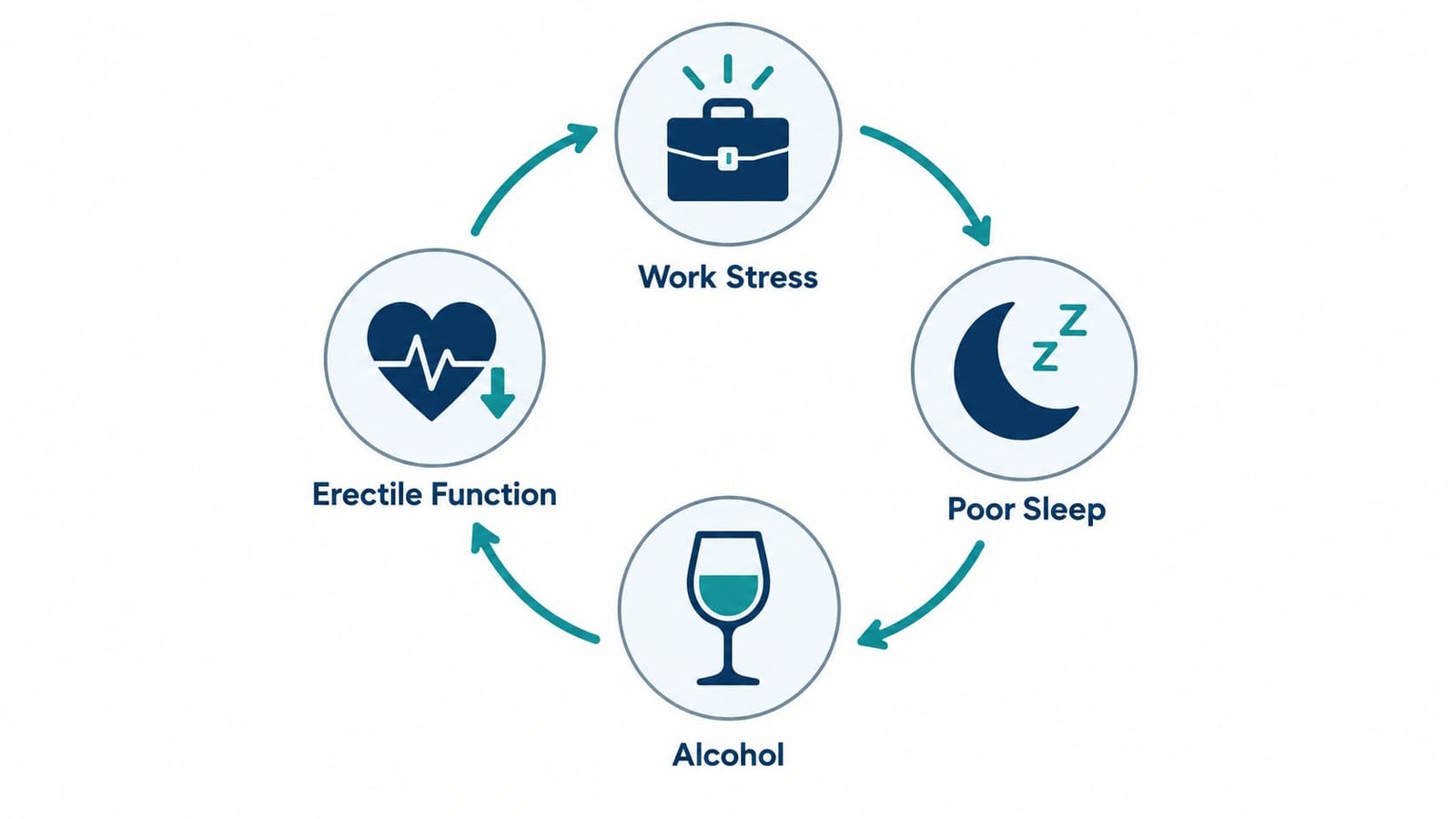
Work stress, short sleep and evening alcohol feed one another. Stress delays sleep onset. A drink may speed sleep onset but fragments the second half of the night. Poor sleep raises next-day cortisol and lowers resilience to pressure. Performance anxiety then encourages further drinking. This cycle explains why stress and ED often appear alongside fatigue, low mood and reduced desire. Smoking, weight gain and inactivity amplify the effect through vascular damage. Clinicians therefore assess all factors together.
When to See a GP
The NHS advises seeing a GP when erection problems persist. ED can be an early marker of cardiovascular disease and diabetes, sometimes years before other symptoms. A GP typically takes a history, measures blood pressure and checks blood glucose or HbA1c and lipids. NICE Clinical Knowledge Summaries also describe a morning testosterone test when symptoms suggest hypogonadism. A medication review matters too, because some antidepressants and blood pressure drugs affect erections. Men should never stop prescribed medication without medical advice.
Evidence-Based Management
First-line care targets cause and symptom together. Management of stress and ED starts with lifestyle change. Regular exercise, smoking cessation, alcohol within limits and steady sleep routines all help. Psychosexual counselling and cognitive behavioural therapy address performance anxiety. NHS Talking Therapies accepts self-referral in England. PDE5 inhibitors, including sildenafil and tadalafil, form the standard drug treatment. These drugs need sexual stimulation and carry contraindications, notably with nitrate medicines. A pharmacist or GP can advise on safe use.
Practical Steps for Work, Sleep and Alcohol
- Schedule breaks and set clear limits on out-of-hours email.
- Fix consistent sleep and wake times, and avoid caffeine late in the day.
- Keep several alcohol-free days each week and track weekly units.
- Aim for 150 minutes of moderate activity weekly, as UK guidelines advise.
Where the P Shot Fits
What the P Shot Is
The P Shot is a trade name for platelet-rich plasma (PRP) injection into penile tissue. Clinicians draw blood, concentrate platelets in a centrifuge and inject the plasma. Several clinics offer P Shot treatment in London, and some group it under sexual rejuvenation London services. Terms such as P Shot London, Priapus Shot London and P Shot UK describe the same PRP procedure.
Evidence and Limits
PRP for male sexual health remains investigational. Small randomised trials report mixed results. Studies differ in PRP preparation, dosing and follow-up, which limits comparison. The European Association of Urology describes PRP for ED as experimental. NICE does not list PRP among first-line options. The P Shot does not treat stress, sleep loss or alcohol misuse. Realistic outcomes range from no change to modest, temporary improvement. Risks include pain, bruising, infection and, rarely, haematoma. Any P Shot for male sexual health should follow medical assessment and proven treatments.
Priapus Shot Price and Informed Consent
Priapus Shot price varies between clinics, depending on PRP kit, protocol and session number. Clinics should publish fees and explain all costs before consent. Men should ask about evidence, risks, alternatives and expected outcomes. The General Medical Council expects doctors to obtain informed consent.
Clinic Context
Dr Syed Nadeem Abbas leads Pshots clinic UK, a private clinic on Harley Street, Marylebone, London. His qualifications include MBBS, MRCS (RCS Edinburgh) and MRCGP. He also holds an MSc in Aesthetic Plastic Surgery with Distinction from Queen Mary University of London. Training took place at Cambridge, Oxford and the Royal London Hospital.
Frequently Asked Questions
Can stress and ED improve without medication?
Often, yes, when the stressor eases. Lifestyle change, better sleep and counselling help many men. Persistent symptoms still warrant a GP review.
Can work stress alone cause erectile dysfunction?
Work stress can trigger or worsen ED through anxiety, raised cortisol and poor sleep. Pressure rarely acts alone, however. Weight, blood pressure, diabetes and smoking often contribute. A GP assessment separates these causes.
How can a man tell whether ED has a psychological or physical cause?
Sudden onset and normal morning erections suggest a psychological cause. Gradual onset and lost morning erections suggest a physical cause. Many men have both. Only clinical assessment confirms the cause.
Does one night of poor sleep cause ED?
One night rarely causes lasting ED. Repeated short sleep over weeks matters more. Snoring or daytime sleepiness warrants a sleep apnoea check.
How many hours of sleep protect erectile function?
Research has set no ED-specific target. Consistent, uninterrupted sleep matters more than any single number. Persistent tiredness despite adequate time in bed justifies a sleep assessment.
How much alcohol is safe for erections?
No exact safe threshold exists. Staying within 14 units weekly lowers general health risks. Heavy drinking sessions impair erections on the night.
Does alcohol affect erections only on the night?
No. Short-term effects fade within hours. Chronic heavy drinking may also damage nerves, lower testosterone and raise blood pressure.
Do professionals face a higher ED risk?
Evidence does not show a distinct risk for any profession. Long hours, sedentary work, travel and pressure concentrate several risk factors, however. Erectile dysfunction in professionals therefore deserves the same checks as any other case.
Which tests can a GP arrange?
A GP usually checks blood pressure, weight, blood glucose or HbA1c and cholesterol. A morning testosterone test follows when symptoms suggest low levels. A medication review forms part of the assessment.
Do ED tablets work when stress is the main cause?
PDE5 inhibitors often help by supporting blood flow, but sexual stimulation remains necessary. Counselling treats the underlying anxiety. Many men use both approaches together. A GP or pharmacist advises on safe use, especially with nitrate medicines.
Can ED return after improving?
Symptoms may recur during periods of high pressure, short sleep or heavy drinking. Sustained habit changes reduce this risk.
When should a young man seek help?
Erection problems lasting more than a few weeks justify review. Checks of blood pressure, glucose and cholesterol come first.
When does ED need urgent attention?
Chest pain, breathlessness or sudden vision change needs urgent assessment. An erection lasting over four hours also needs emergency care.
Can the P Shot treat stress-related or alcohol-related ED?
The P Shot targets penile tissue, not the underlying cause. It does not reduce cortisol, restore sleep or limit drinking. Correcting these factors comes first.
What determines Priapus Shot price?
Priapus Shot price varies by clinic, PRP protocol and session number. Clinics offering P Shot treatment in London publish different fees. Reputable clinics state all costs before consent. Price does not indicate effectiveness.
Do guidelines recommend the P Shot?
No. Guidelines do not recommend PRP as standard ED treatment. Evidence remains limited, and trials continue.
Conclusion
Stress, short sleep and alcohol each affect erections through nerves, hormones and blood vessels. Alone, each factor rarely explains ED. Combined, the three factors form a cycle that sustains symptoms. Stress and ED deserve the same careful assessment as any other health concern.
Informed decisions start with evidence: assess causes, correct habits, then weigh treatments with clear limits. A GP review remains the sensible first step. Specialist options, including the P Shot, belong after assessment and an honest discussion of uncertainty.
If erections respond to the same signals as the heart, what might current habits reveal about long-term health?
Read more:
Priapus Shot London: A Complete Guide for Patients Considering Treatment
How Do Doctors Measure P-Shot Success? Erections, Sensitivity and Other Outcomes
Dr Syed Nadeem Abbas, MBBS, MRCSEd, MSc Aesthetic Plastic Surgery (Distinction) Medical Director, Pshot Clinic | CQC Regulated | Monday to Saturday 10:00–18:00 +44 7955 836986


