
Two vials of platelet-rich plasma can look identical. Each shows the same straw-yellow colour. One arm may have supplied both. Yet the platelet content inside can differ several-fold. That hidden difference sits at the centre of the debate around dual-spin PRP.
Men who research a P Shot London appointment meet the terms “single-spin” and “double-spin” early. Clinic websites often declare one method superior. Few explain the reasoning, and fewer cite evidence. Patients who want clear facts about the P Shot for male sexual health deserve better than slogans.
The question has a precise answer. Spin count describes a laboratory workflow. Platelet concentration describes the product. Clinical benefit depends on the product, the target tissue and the patient. Searches for Priapus Shot London providers and sexual rejuvenation London services rarely surface that distinction.
This article compares single-spin and double-spin methods using published laboratory and clinical data. It explains platelet concentration, total platelet dose and recovery rate. The text also states what the evidence cannot yet show. Published randomised trials have not shown that higher platelet concentration improves results after a P Shot. Readers can use the findings to ask sharper questions before any consultation.
What PRP Contains and Why Preparation Matters
Platelet-rich plasma is an autologous blood product. A clinician draws venous blood and spins it in a centrifuge. The spin separates components by density. Red cells sink, and a platelet-rich plasma layer rises above.
Platelets store growth factors, including platelet-derived growth factor and vascular endothelial growth factor. Laboratory studies link these molecules to collagen production and new blood vessel formation. That biology explains the interest in PRP for erectile tissue.
Preparation decides what reaches the syringe. Different methods yield different concentrations, volumes and cell mixtures. PRP is a family of products, not a single product.
The One Million Platelet Benchmark
Healthy adults carry roughly 150,000 to 450,000 platelets per microlitre of blood. Marx proposed in 2004 that therapeutic PRP should contain at least one million platelets per microlitre. That level equals about four times a typical baseline count. Marx drew the figure from bone graft research. No equivalent threshold exists for penile tissue.
How Single-Spin PRP Works
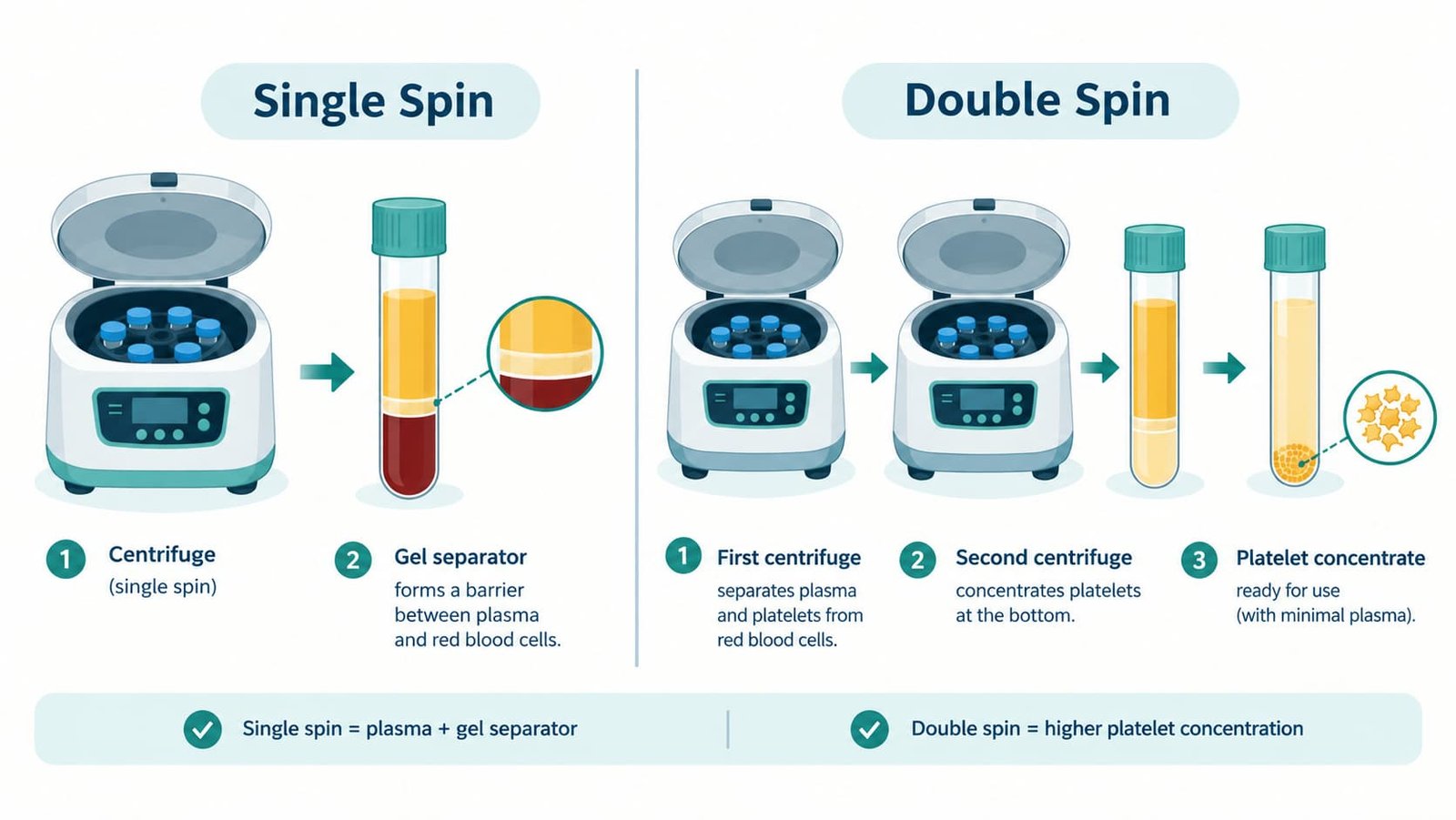
Single-spin systems use one centrifuge cycle. Red cells settle at the bottom of the tube. A plasma layer holding platelets rises above. The clinician collects that upper layer.
Many commercial kits add a separator gel to the tube. The gel settles between red cells and plasma during the spin. This barrier reduces handling and limits red cell contamination.
Single-spin protocols shorten preparation time and reduce transfer steps. They also leave plasma volume relatively large. Platelet concentration therefore often sits lower than in a well-run dual-spin protocol. Kit design changes this pattern, so published results vary widely.
How Dual-Spin PRP Works
Dual-spin PRP uses two sequential centrifuge cycles. The first spin separates red cells from plasma. The clinician moves the plasma into a second tube. The second spin packs platelets into a pellet at the bottom.
The clinician then removes most of the platelet-poor plasma above the pellet. Resuspending the pellet in a small volume creates a concentrated product. Dual-spin PRP therefore separates platelet concentration from final volume. A clinic can choose a small volume with a high platelet concentration.
The method carries trade-offs. Extra transfer steps can lose platelets. Pipetting errors can draw red cells into the product. Handling can trigger early platelet activation. Operator technique therefore influences dual-spin PRP quality more than it influences gel-based single-spin systems. Dhurat and Sukesh reviewed both approaches in 2014 and noted wide protocol variation between laboratories.
Dual-Spin PRP vs Single-Spin PRP: Key Differences
| Feature | Single-spin | Dual-spin |
| Centrifuge cycles | One | Two |
| Handling steps | Fewer | More, including plasma transfer |
| Concentration potential | Often lower | Often higher |
| Final volume control | Limited by kit design | Flexible |
| Contamination risk | Low with gel tubes | Higher if transfer is imprecise |
| Operator dependence | Lower | Higher |
| Preparation time | Shorter | Longer |
Table values describe general tendencies. Individual kits and operators change each row.
Does Platelet Concentration Matter for the P Shot?
The evidence supports a cautious answer.The platelet concentration may be relevant, but no clinical trial has established that a higher concentration improves outcomes for erectile dysfunction.
Concentration, Volume and Total Dose
Concentration measures platelets per unit of volume. Total dose measures all platelets delivered. Three inputs set both: the baseline platelet count, the blood volume drawn and the system’s recovery rate. A small total volume, often a few millilitres across several sites, makes the concentration question practical.
The next figures are illustrative only. A patient has a baseline count of 250,000 per microlitre. A clinician draws 20 mL of blood, which holds about 5 billion platelets. A system with 60 percent recovery captures 3 billion platelets. Suspending the platelets in 3 mL yields roughly one million per microlitre, or four times baseline.
A system with 30 percent recovery captures 1.5 billion platelets. The same 3 mL then holds about 500,000 per microlitre. Recovery rate can change the product as much as spin count does. These numbers show arithmetic. They do not describe any specific clinic protocol.
What Research Says About Spin Method
Published comparisons give mixed results. Some laboratory studies report higher concentrations after double centrifugation. Others report higher yields from optimised single-spin protocols. Perez and colleagues showed in 2014 that centrifuge acceleration, time and volume changed platelet recovery markedly within one method. Spin count alone therefore predicts little about the final product.
What Erectile Dysfunction Trials Show
A 2021 Journal of Sexual Medicine randomised trial reported improved erectile function scores after PRP injection. A 2023 European Urology randomised trial found less consistent benefit. Neither trial compared preparation methods.
Some orthopaedic analyses link higher platelet doses with better outcomes, mainly in knee osteoarthritis. Penile tissue differs in structure, blood supply and treatment goal. Extrapolation therefore carries uncertainty. Higher concentration remains a biological hypothesis for the penis, not a proven clinical advantage.
The European Association of Urology guidelines treat intracavernosal PRP as investigational. NICE Clinical Knowledge Summaries recommend phosphodiesterase type 5 inhibitors first and do not list PRP as a routine option. The NHS erectile dysfunction pages likewise list tablets, devices, injections and surgery, not PRP.
Other Variables That Shape the Final Product
Spin method forms one variable among many. Four others deserve attention.
Recovery Rate and Blood Volume
Recovery rate measures the share of platelets captured from the original sample. Manufacturers publish average figures. Individual results vary with baseline count, haematocrit and technique. Larger draws raise the starting platelet total, while draw volumes differ between clinics.
Leukocytes and Red Cells
Leukocyte-poor PRP contains few white cells. Leukocyte-rich PRP retains them. Tissue models link red cell contamination with inflammation and oxidative stress. Careful aspiration lowers contamination in both single-spin and dual-spin PRP systems. No consensus defines the ideal leukocyte content for the P Shot.
Anticoagulant and Activation
Acid citrate dextrose solution A preserves platelet integrity well in comparative work. Heparin and EDTA can impair platelet function or trigger early activation. Some clinicians activate PRP with calcium chloride before injection. Others allow tissue contact to trigger growth factor release. No consensus favours either approach for the P Shot.
Reporting Standards
Chahla and colleagues reviewed orthopaedic PRP studies in 2017 and found that most omitted key composition data. Poor reporting blocks fair comparison between protocols. The DEPA classification, covering dose, efficiency, purity and activation, offers one framework for clearer description. Patients can ask whether a clinic reports preparation data in that format.
Realistic Outcomes and Limits in Clinical Practice
What Patients Can Realistically Expect
Responses to PRP vary. Age, diabetes, vascular disease, smoking and medication all affect erectile tissue. Preparation cannot override these factors. Some men notice gradual change over weeks to months. Others notice no change.
No P Shot treatment London clinic can guarantee an outcome. Honest consultations discuss the evidence gap, exclusion criteria and alternatives. Alternatives include lifestyle change, PDE5 inhibitors, vacuum devices and psychosexual therapy.
Priapus Shot Price and Platelet Quality
Priapus Shot Price in the UK varies by practitioner, protocol and inclusions. Published London prices span roughly £900 to £3,000. A higher price does not prove a higher platelet concentration. Patients should ask what the fee covers, including consultation, preparation system and follow-up reviews. P Shot UK providers differ widely on these points.
One Clinic’s Approach
The pshots clinic in Marylebone, London, uses a dual-spin PRP protocol. Dr Syed Nadeem Abbas leads the clinic. Dr Abbas holds MBBS, MRCS (RCS Edinburgh) and MRCGP qualifications. An MSc in Aesthetic Plastic Surgery with Distinction from Queen Mary University of London adds further training. Training also took place at Cambridge, Oxford and the Royal London Hospital. Method alone does not prove superior outcomes. The questions below apply to every provider.
How to Assess a Clinic’s PRP Preparation
Questions Worth Asking
Patients can raise six practical questions at consultation:
- Which centrifuge and PRP kit does the clinic use, and does the device carry UKCA or CE marking?
- Does the clinic use single-spin or dual-spin PRP, and why?
- Does the clinic measure platelet counts, or rely on manufacturer averages?
- Which anticoagulant does the kit contain?
- Does the practitioner activate the PRP before injection?
- What does the fee include, and how many follow-up reviews occur?
Regulation and Clinical Governance
The Care Quality Commission regulates private clinics that provide regulated activities in England. The General Medical Council register allows the public to confirm a doctor’s licence to practise. The NHS does not fund the P Shot for erectile dysfunction. Patients should expect clear written consent that states the investigational status of the treatment.
Frequently Asked Questions
Questions About Preparation
Is dual-spin PRP better than single-spin PRP?
Neither method wins as a category. Dual-spin protocols often reach higher concentrations in smaller volumes. Single-spin kits often offer simpler, more consistent handling. Recovery rate, blood volume and operator skill decide the final product.
What platelet concentration does the P Shot require?
No validated target exists for erectile tissue. The one million per microlitre benchmark comes from bone graft research. Clinics set protocols using manufacturer guidance and clinical judgement, not trial-proven thresholds.
Does a clinic need to measure platelet counts?
Measurement gives the only direct confirmation of the delivered dose. Many protocols rely on manufacturer averages instead. Patients can ask which approach a clinic follows and how the clinic documents it.
Questions About the Treatment
How long does PRP preparation take?
Processing often takes 15 to 30 minutes, depending on the system and spin method. Dual-spin protocols run longer than single-spin protocols. The full appointment, including consultation, anaesthesia and injection, takes longer.
Is PRP safe because it uses the patient’s own blood?
Autologous PRP carries a very low risk of allergic reaction. Injection-related risks remain, including bruising, swelling, infection and discomfort. Sterile technique and screening for bleeding disorders and anticoagulant use reduce the risk.
Will a higher platelet concentration give better results?
Evidence does not yet confirm that. Randomised trials in erectile dysfunction have not tested platelet dose directly. Outcomes also depend on the cause of erectile dysfunction, vascular health and patient selection.
Key Takeaways
Spin count describes how a clinic prepares PRP. It does not guarantee what the syringe contains. Platelet concentration, total dose, recovery rate and cell purity all shape the final product. For the P Shot, the link between those variables and clinical outcomes remains unproven.
Informed decisions rest on evidence, not terminology. Patients can ask clinics to explain the preparation system, the measurement approach and the realistic outcomes. A GP or urologist can assess the causes of erectile dysfunction and discuss established treatments.
If no trial yet links platelet concentration to better erections, what evidence should a clinic provide before a patient commits to a P Shot?
Read more: How Do Doctors Measure P-Shot Success? Erections, Sensitivity and Other Outcomes
P Shot in London: Complete Guide to Treatment, Suitability, Results, Risks and Costs
Dr Syed Nadeem Abbas, MBBS, MRCSEd, MSc Aesthetic Plastic Surgery (Distinction) Medical Director, Pshot Clinic | CQC Regulated | Monday to Saturday 10:00–18:00 +44 7955 836986


