How Do Doctors Measure P-Shot Success? Erections, Sensitivity and Other Outcomes

✅Medically reviewed | Updated September 2026
Men across the UK search for information about the P shot. Few find a clear explanation of how doctors judge the results. Clinic websites describe firmer erections and greater sensitivity. Cleveland Clinic states that clinical trials have not shown improved erections and calls the procedure experimental. Both positions leave one practical question. What counts as evidence?
That question sits at the centre of P-Shot success. A man may feel improvement while a scan shows no change. Another man may score higher on a questionnaire yet notice no difference during sex. Clinicians therefore use several tools rather than one number.
This article explains those tools in plain terms. Later sections cover erection scores, hardness grading, Doppler ultrasound, sensitivity testing, curvature measurement and safety review. Each section also explains what the research shows and where limits remain. The P shot, also called the Priapus shot, uses platelet-rich plasma (PRP). Clinicians draw PRP from the patient’s own blood and inject penile tissue. Understanding the measurements protects every patient from unrealistic expectations.
What Does P-Shot Success Mean in Clinical Terms?
Doctors define success against a stated goal. The goal must exist before treatment starts. Without a baseline, no clinician can judge change.
Different Goals Need Different Measures
Men seek the P shot for several reasons. Some want firmer erections. Others want greater sensitivity, less penile curvature or renewed confidence. Each goal needs a separate outcome measure. A questionnaire about erections cannot capture sensitivity. One success rate cannot describe every outcome.
Efficacy, Effectiveness and Satisfaction
Researchers separate three ideas. Efficacy describes change under trial conditions. Effectiveness describes change in routine care. Satisfaction describes how the patient feels about the change. A treatment can score well on one and poorly on another. Strong P-Shot success therefore requires agreement across several measures, not one positive result.
How Doctors Measure Erectile Outcomes
Erectile dysfunction (ED) is the most studied target of the P shot treatment. Clinicians measure erectile change with validated questionnaires first, then add objective tests where needed. NICE Clinical Knowledge Summaries describe a structured ED assessment. That assessment covers sexual history, cardiovascular risk and blood tests. NHS guidance advises men to see a GP first, because ED can signal heart disease or diabetes.
The IIEF-5 and IIEF-EF Questionnaires
The International Index of Erectile Function (IIEF) is the standard research questionnaire. The full version contains 15 questions across five domains. The erectile function domain (IIEF-EF) scores from 1 to 30. The short version, IIEF-5, scores from 5 to 25. Many clinicians use the short version in routine practice.
Scores place men into severity bands. An IIEF-5 score of 22 to 25 suggests no ED. A score of 5 to 7 suggests severe ED. Repeating the same questionnaire before and after treatment shows the direction of change.
What Counts as a Meaningful Change
A statistical change does not always matter to a patient. Researchers therefore use the minimal clinically important difference (MCID). Published IIEF-EF estimates are 2 points for mild ED, 5 for moderate ED and 7 for severe ED. Smaller changes may reflect normal variation between test days.
The Erection Hardness Score
The Erection Hardness Score (EHS) grades rigidity from 0 to 4. An enlarged penis that remains soft is classified as Grade 1. With Grade 2, the erection is too soft to allow penetration. Penetration is possible at Grade 3, although the erection does not reach full rigidity. A completely hard and fully rigid erection is classified as Grade 4. Grades 3 and 4 usually allow satisfactory intercourse. The scale takes seconds to complete, so clinics use it at every review.
Sexual Encounter Profile Diaries
Sexual Encounter Profile (SEP) diaries record each attempt at intercourse. Question SEP2 asks whether penetration succeeded. Question SEP3 asks whether the erection lasted until completion. Drug trials commonly use these questions as primary endpoints. Diaries reduce recall bias because men log events soon after each attempt.
Penile Doppler Ultrasound
Doppler ultrasound serves as the main objective test. A clinician injects a vasoactive drug, then measures blood flow in the penile arteries. A peak systolic velocity above 30 cm/s usually indicates healthy arterial inflow. An end-diastolic velocity above 5 cm/s suggests venous leakage.
Specialist urology units use this test when the cause remains unclear. Most private clinics do not offer it routinely. Fewer P shot studies report Doppler findings than questionnaire scores. Objective vascular proof therefore remains limited.

How Doctors Assess Sensitivity
Sensitivity claims appear often in P shot marketing. Measurement of sensitivity remains far less standard. No universally accepted questionnaire exists for glans sensitivity. Cleveland Clinic states that no scientific evidence supports sensitivity claims.
Subjective Sensitivity Scales
Researchers commonly use a visual analogue scale from 0 to 10. Patients rate sensation before treatment and at each review. The IIEF orgasmic function domain adds a second perspective. Patient-reported scales capture what matters to the patient, but these scales also carry bias.
Objective Sensory Testing
Biothesiometry measures the vibration perception threshold on the shaft and glans. Neurologists use similar quantitative sensory testing to assess nerve damage. Results vary with arousal, anxiety, skin temperature and examiner technique. These tests appear mainly in research settings. Routine clinics rarely use such tests.
Other Outcomes Doctors Track
Penile Curvature and Plaque
Peyronie’s disease causes scar tissue that bends the penis. NHS information advises men with new curvature or pain to see a GP. Clinicians measure curvature with a goniometer, usually after an induced erection. Ultrasound records plaque size. The Peyronie’s Disease Questionnaire (PDQ) records bother and function. Cleveland Clinic reports no good scientific evidence for the P shot in Peyronie’s disease.
Penile Length and Girth
Some websites use terms such as penis shot and male enlargement injections. Research on penile size uses stretched length, measured from the pubic bone to the glans tip. Measurements differ by several millimetres between examiners. Small changes therefore fall within measurement error.
No trial shows that PRP produces lasting penile injection growth. Cleveland Clinic states that scientific evidence does not support size claims. Fillers and PRP also work differently. Fillers add volume, whereas PRP delivers growth factors from platelets.
Ejaculatory Control and Orgasm
Researchers time ejaculation with a stopwatch, called the intravaginal ejaculatory latency time (IELT). The Premature Ejaculation Diagnostic Tool (PEDT) adds a five-question screen. No large trial has tested the P shot against these measures. Claims about ejaculatory control therefore rest on weak evidence.
Satisfaction and Global Impression
The IIEF includes domains for intercourse satisfaction and overall satisfaction. Many studies also ask one global question: has treatment improved erections? The question is simple but blunt. A yes or no answer cannot show the degree of change.
Safety and Adverse Events
Safety counts as an outcome. Clinicians record bruising, swelling, discolouration, pain, numbness and infection. Cleveland Clinic lists bruising, discolouration, swelling and infection as minor risks. Signs of infection, worsening pain or numbness lasting more than a few hours need prompt medical review.
When Doctors Measure Results
Timing shapes every measurement. PRP triggers a gradual tissue response, so early checks can mislead. Trials commonly review outcomes at one, three and six months. Cleveland Clinic notes that some men report changes within days, while others wait months.
A practical schedule includes four points:
- Baseline: questionnaire scores, hardness grade, medical history and goals.
- Four to six weeks: early review and safety check.
- Three months: main outcome review with the same questionnaires.
- Six to twelve months: durability check and decision on further sessions.
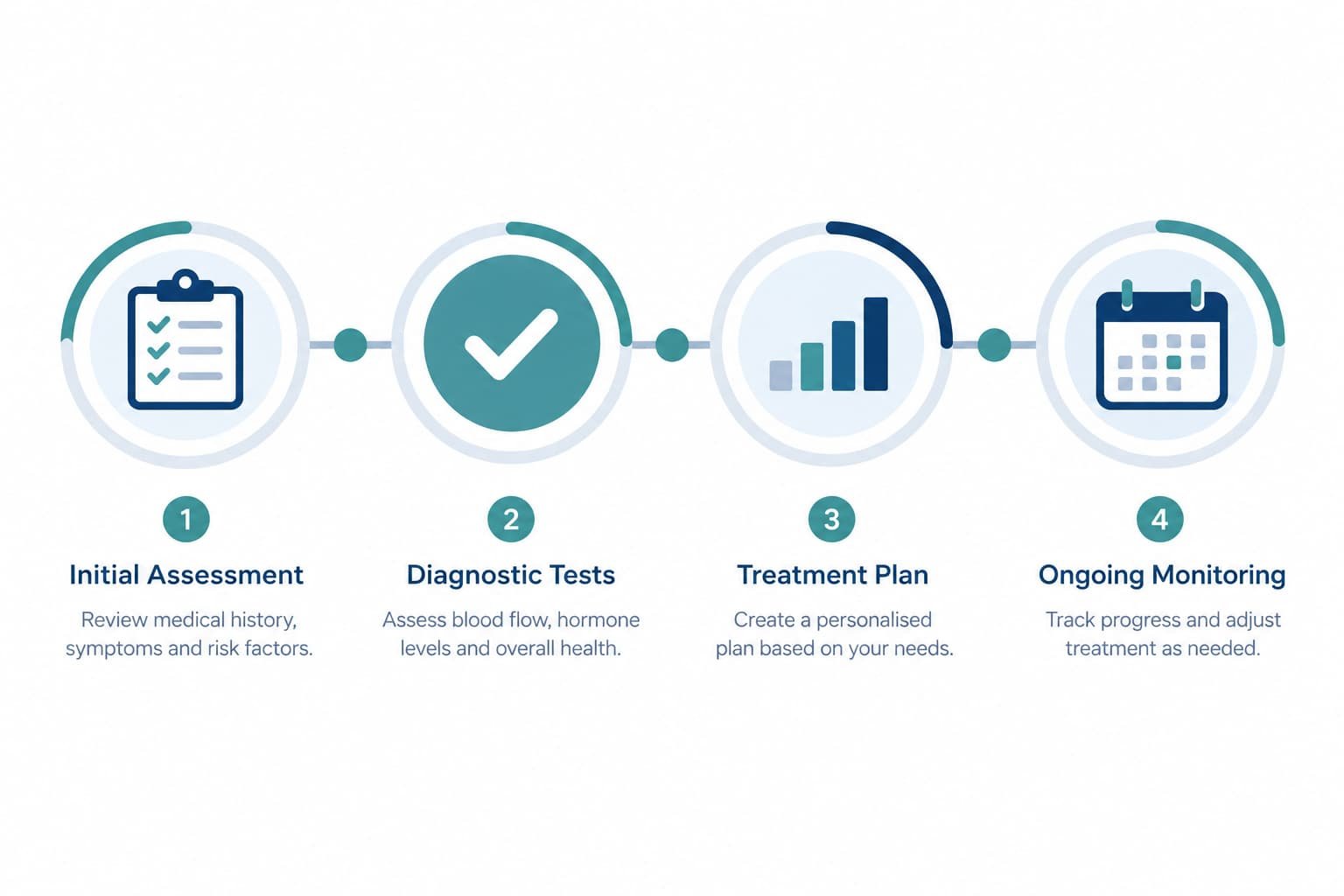
Using the same tools at each visit keeps comparison fair.
Why Measuring P-Shot Success Is Difficult
Placebo Response
Sexual function responds strongly to expectation. Placebo groups in ED trials often improve, even without active treatment. An injection procedure can raise expectation further. Placebo-controlled trials separate real effect from expectation. Uncontrolled reports cannot.
Regression to the Mean
Men often seek treatment when symptoms peak. Symptoms then fluctuate naturally, and scores may improve without any treatment. Repeated measurement and control groups reduce this error.
Lifestyle Changes and Other Treatments
Men often change habits around the time of treatment. NHS advice lists regular exercise, healthy eating, stopping smoking and reducing alcohol as helpful for ED. Some men also start counselling or medication. Each change can raise scores and blur the effect of PRP.
P Shot Before and After Photos
A P shot before and after photo shows appearance, not function. Lighting, camera angle, room temperature and arousal level all alter appearance. Photos cannot show hardness, sensation or sexual performance. P-shot before and after images rarely qualify as clinical evidence. Serious clinics pair photos with recorded scores taken under consistent conditions.
What the Research Currently Shows
Cleveland Clinic classes the P shot as experimental and reports no good evidence of benefit for ED. The European Association of Urology treats PRP as investigational. Its guidance supports use within research settings. NICE Clinical Knowledge Summaries continue to recommend PDE5 inhibitors as first-line ED treatment. NHS services do not routinely offer the P shot.
A small 2021 placebo-controlled trial in the Journal of Sexual Medicine reported clinically meaningful gains in erectile scores after PRP. A later double-blind trial in European Urology in 2023 found less consistent benefit. Trial sizes remain small. Protocols differ in PRP preparation, injection number and follow-up length. Few studies follow patients beyond twelve months.
P-Shot success in research therefore means meaningful change against placebo, on validated scales, over a defined period. Current evidence supports cautious interest, not confident promises.
Setting Realistic Outcome Expectations
Realistic expectations depend on the starting point. Men with mild vascular ED may respond differently from men with nerve damage after pelvic surgery. Diabetes, smoking, medication and low testosterone also change the likely response. NICE Clinical Knowledge Summaries list these factors as common causes of ED. Treating these causes first often improves scores.
What a Reasonable Goal Looks Like
A reasonable goal names one measure and one target. For example, a patient may aim to move from EHS grade 2 to grade 3. Another patient may aim to raise an IIEF-EF score by the MCID for the current severity band. Specific goals turn vague hope into a testable outcome.
When to Reassess
Clinicians reassess if scores fail to change by the three-month review. Options then include further investigation, another treatment or stopping. Cleveland Clinic advises men to continue only when a benefit appears and expectations stay realistic. Repeating injections without measurable gain adds cost without evidence.
Cost and Access in the UK
Private clinics set P shot UK prices individually. The typical priapus shot price in London ranges from £900 to £1,500 per session. Price depends on PRP preparation, practitioner experience and included follow-up. Searches for male enlargement injections cost uk often mix PRP with unrelated products. Patients should compare what each fee includes.
A useful question costs nothing. Which measurement tools does the clinic use at baseline and follow-up? A clinic that defines P-Shot success in advance gives patients a factual basis for later decisions.
Choosing a Practitioner for P Shot London Care
NHS guidance advises a GP visit before any private ED treatment. A GP can check cardiovascular risk, diabetes, hormone levels and medication effects. Cleveland Clinic advises patients to ask about practitioner qualifications and experience. Patients should also confirm GMC registration and CQC registration for the clinic.
Some clinics label the procedure a p injection or Pshot. The name matters less than the method. Patients should ask how the clinic prepares PRP, which sites receive injection and how the clinic measures outcomes. Patients should also ask what happens if no change occurs.
Pshots clinic UK is a Harley Street, Marylebone practice led by Dr Syed Nadeem Abbas. Dr Abbas holds an MBBS, MRCS (RCS Edinburgh) and MRCGP. He also holds an MSc in Aesthetic Plastic Surgery, with Distinction, from Queen Mary University of London. Training took place at Cambridge, Oxford and the Royal London Hospital. The practice offers the P shot treatment discussed in this article.
Frequently Asked Questions
How Do Doctors Define P-Shot Success?
Doctors define success against goals set before treatment. Common measures include IIEF scores, hardness grades, sensitivity ratings and safety records. Meaningful change means exceeding the minimal clinically important difference, not any small rise.
Which Questionnaire Measures Erections?
The IIEF-5 and IIEF-EF measure erectile function. Many clinicians use the IIEF-5 in routine care. Researchers use the longer IIEF in trials.
Can the P Shot Increase Penis Size?
No reliable evidence shows this. Cleveland Clinic states that scientific evidence does not support size claims. Measurement error can also mimic small changes.
When Do Results Appear?
Timing varies. Cleveland Clinic notes that some men report changes within days, while others wait several months or see none. Trials commonly assess outcomes at one, three and six months.
Is the P Shot Safe?
Cleveland Clinic describes the procedure as relatively safe. Minor risks include bruising, discolouration, swelling and infection. Any signs of infection need prompt medical review.
Does the NHS Offer the P Shot?
NHS services do not routinely offer it. NHS and NICE guidance places PDE5 inhibitors, lifestyle change and psychological support ahead of PRP.
Conclusion: Measure First, Decide Second
Good decisions start with good measurement. Doctors track erections with IIEF scores, hardness grades and diaries. Doppler ultrasound adds objective vascular data. Sensitivity, curvature, ejaculatory control and safety each need separate tools. No single number can describe every outcome.
Evidence for PRP remains mixed. Cleveland Clinic calls the procedure experimental. A 2021 trial reported gains, yet a 2023 trial found less consistent benefit. Placebo response, natural fluctuation and photo limits complicate every result. Clear definitions of P-Shot success, set before treatment, protect patients from disappointment.
Anyone considering the P shot should see a GP first, compare fees and ask how outcomes get measured. Informed decisions rest on evidence, not on marketing. If no measurement existed, how could any man judge whether treatment truly worked?
Read more:
What Is the P-Shot Success Rate? What the Research Really Shows
P-Shot Success Rate by Age: Do Results Differ in Your 40s, 50s and 60s?
Dr Syed Nadeem Abbas, MBBS, MRCSEd, MSc Aesthetic Plastic Surgery (Distinction) Medical Director, Pshot Clinic | CQC Regulated | Monday to Saturday 10:00–18:00 +44 7955 836986